

Episode 1: “Distilled Spirits”
Caitlyn
——————————————————————————————————————————————————–
Like an underreported % of Americans, Caitlyn is an addict.
Like a smaller % of them, she knows this.
Like many fortunate young women, Cait has a partner who loves her.
Like too many unfortunate young women, she knows she has to break up with him.
Repetition and decisions.
Angst and nihilism evolved beyond just a phase, perfected into a comfortable cycle.
Cait has identified a lot of her problems, but what she doesn’t want to hear are any solutions. And her friend she’s meeting at the airport is always full of them.
————————————————————————————————————————————–
“Mrs. Emma Cranst, please come to a white courtesy telephone.”
Cait waited with a number of normal-looking people beside the baggage carrousel. With her sunglasses on, the fluorescent lights were dimmed and everybody took on the same hues—Latin couple waiting for someone, black businessman talking business on the phone, white-shirted security guards making their rounds—Cait’s world existed in a handful of simple colors.
An old man in a tweed suit had been eying her from across the carousel. A second or two on her face, a few more on her chest, and then he would glance away. Cait waited until the man looked again, then she flashed a small, demure-secretary’s smile.
The old man smiled.
Cait showed her teeth and reached up, pulling her false canine free from her mouth. She stuck her tongue in the gap and wiggled it around and the old man’s face whitened, quickly finding something else to gawk at.
“Mrs. Emma Cranst, please come to the white courtesy telephone.
A TSA agent held open the doors to the security area, maybe keeping an eye out for Emma—Emma the potential threat?—and a stream of people burst into the concourse. Glenn’s flight. Most had their tired eyes on the baggage carousel that had begun rotating moments before, the display reading: Copa Airlines No. 1804.
Cait’s gaze flicked over the passengers, over the lovers and families embracing and the lonesome few with thoughts only for luggage. Glenn was one of the last—he and a stooped Colombian grandmother who walked with one hand on a cane, and the other on Glenn’s arm. He carried a heavy-looking purse and the two of them made a slow line toward her family. A stout man in a suit took the purse from Glenn and shook his hand, thanking him. The grandmother clung to Glenn’s arm during the exchange and it wasn’t until a young boy took his place that he was allowed to leave, waving over his shoulder.
Glenn’s smile widened when he saw Cait waiting for him, and he walked over, keeping one eye on the carousel. His deep tan was new since he left the country and it matched the warm glow that always surrounded him, or so Cait sometimes imagined. Her friend had an annoying habit of genuinely making her feel better most times they hung out.
“Caitlyn! What’re you doing here? Thought Geno would meet me.”
“He picked up a new gig—some landscaping deal—and Sid’s hungover,” Cait said.
“You guys get into it pretty heavy last night? One sec—” Glenn grabbed his only bag, a worn backpacker’s backpack, and shouldered it. He looked at Cait, expecting a story.
“Nothing happened,” she said. “Sid was celebrating a new project. Another crappy flash game, but this developer actually has a budget.”
Glenn gestured at the exit and they stepped outside, into the line for taxis. It was a warm morning but Cait shivered in long sleeves and jeans. A cigarette was lit and at Glenn’s mouth in one smooth motion.
“Don’t say anything,” he said. “It was Colombia. Everyone smokes there.”
Cait shook her head. “Just don’t quote Vonnegut as an excuse this time.”
The line dwindled as the cabs cycled. Glenn crushed his cigarette on his shoe and tossed it in the bin when their taxi stopped. He threw his backpack in the popped trunk before the driver could help him.
“The Inner Harbor,” Glenn said after he got in the back with Cait.
“Wait,” Cait said, “sorry, do you think you can drop me at St. Anthony’s, over the bridge?”
Glenn sighed and told the driver to head to the hospital first, and Cait leaned back in her seat.
“You’re still with Blanks, huh?” Glenn asked.
“You were gone for less than a month,” Cait said. “Drew’s doing well, thanks. He got his anesthetist certification last week.”
“I’m sure it’s very convenient,” Glenn said while staring out the window.
Despite knowing him since high school, Cait hated this. Whenever Glenn came back from a volunteer adventure to some poor country, he was always like this. High on help.
Even Geno barely tolerated it.
“Did you save a bunch of Colombia babies while down there, or what?” Cait muttered.
“We were building houses.”
The rest of the trip to South Harbor’s hospital was quiet. Cait kept her sunglasses on as they passed through Geno and Glenn’s neighborhood and over the USS Stinger St. Bridge. She had still never visited that aircraft carrier-turned-museum.
The rays of the peaking sun on the rich side of the harbor were washed out and so were the faces of waterside joggers, smiling Saturday lunchers, and dog walkers going wherever they went.
The taxi stopped at St. Anthony’s and Cait opened the door.
Glenn caught her arm. “You know that if you need—I mean, I know some people who—”
Cait shook him off. “Not today, okay?”
“Why are you wearing long sleeves?”
“Fuck off, Glenn. You know needles freak me out. Go rescue a kitten, will you?” Cait slammed the door and the driver took the cue.
Drew was in reception when Cait walked through the hospital’s automatic doors, air conditioning blasting away. He was talking with a group of young, pretty nurses who probably had somewhere else to be. Cait sat down in the waiting area like they had decided earlier.
After a few minutes, the other nurses remembered they were on-call, and Drew came over, wielding a clipboard.
“Ms. Hash? Caitlyn Hash?”
Cait put down her magazine. “Yes?”
“Come with me, please.” He waved her out of the reception area with his clipboard.
They both knew the routine. Nobody would bother a senior nurse guiding a patient toward examination rooms. Drew nodded his way past custodians, coworkers, and an exhausted surgeon–each had at least a fake smile for him. He stopped Cait with a hand on her shoulder in front of a storage closet around one corner. He looked both ways and they quickly slipped inside, turning the light on. The shelves were taken up by excess supplies—gauze, wraps, gloves—it was like a walk-in first aid kit.
“Ah, here it is.” Drew’s hand snaked behind a tower of tissue boxes and pulled out a small orange bottle with no label. It was usually there, or in a different closet. Drew’s friend liked to change it up. A mysteriously appearing unmarked bottle of morphine tabs could cause a lot of trouble.
He tossed the bottle to Cait and she caught it with two hands. “Save some for me, okay?”
“It’s a full bottle, Drew,” she said, eying the contents.
“Put it away,” he commanded and Cait pocketed the bottle. “Now,” he said, pulling her closer by the hips, “I’m on-call till midnight.”
Drew leaned down and kissed Cait, and after a few seconds, she kissed back. He pushed her against the wall and light switch—off—Cait’s sunglasses fell to the floor. She could feel his beating heart.
His hand snuck under her shirt and pulled her bra down, knee between her thighs.
“Wait,” Cait said, turning her face away.
Drew’s mouth found hers again.
“Stop,” Cait mumbled. “I don’t want to. Not here.”
She was suddenly free, the pressure from his body gone. “I’m sorry,” she said. “I’ll see you tonight.”
“No, I’m sorry,” Drew said, turning on the light and picking up her sunglasses. He was smiling. “I just miss you, Caitlyn.”
She nodded and opened the door. “Tonight, okay?”
No one bothered her in the hallways and Cait knew the right things to say if anyone did.
“Were you just seen by Nurse Blanks?” The receptionist was talking—trying to get Cait’s attention as she passed. The woman was in her 40s. “Isn’t he just great?”
“Yes,” Cait said. “He’s wonderful.”
When she got outside, the breeze chilled the sweat on the back of her neck and she shivered. There were no taxis around, not that she could afford it.
Normal-looking people were waiting at the bus stop that would take Cait home, and probably more were below at the subway that would do the same. Instead, Cait walked toward the bridge and reached into her pocket. She broke a tab in half and put it under her tongue, swirling it around. The world muted when she slipped her shades off her forehead—dull colors, dull people, and dull sounds fading.
_______________________________________________________________________________________________________________________
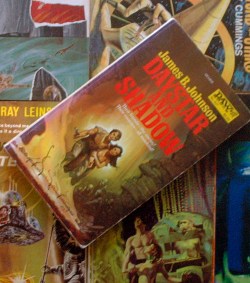
Title: Daystar and Shadow
Listed Author: James B. Johnson
Publishing Information: Paperback, 1981, DAW Books
Pages: 206
_______________________________________________________________________________________________________
“I was remembering more every day. That is, I recalled small bits, when somebody wasn’t trying to kill me and run me all over the deserts of southwest America. And, hell, I’d lost the girl to them, too. But one of these days, I’d remember the lost years. It had taken me years of concentrated effort to drag my given name from the quagmire of lost memory.” (page 1)
You’re thinking that you’ve read this novel before, aren’t you? I certainly thought so after reading the back and subsequent first few pages. Futuristic deserts of America. Lost memory. Girl problems. And people chasing the protagonist. A pretty straight forward recipe for commute reading material, huh? A somewhat bleak picture to kick off Ronald Reagan’s first term.
If you gave up during the first chapter, these thoughts might’ve been as far as you got. But from the 2nd chapter onward, as the puzzles of past and present merge, and as the trials of a disinterested hero (Daystar) and his bosomy young partner (Shadow) evolve beyond mere survival, a pretty fun novel takes shape that assumes a surprising amount of risks.
Daystar and Shadow, published by DAW Books which could be considered the spiritual successor to the playful yet sometimes groundbreaking ACE Double Novels, does not have illusions of grandeur–but after a somewhat brisk 206 pages, I was happy to find the content deeper than I expected.

An example of the fun and often engrossing ACE Double Novels–two stories in one bound paperback
The biggest risk that Mr. Johnson takes is the mental condition of Daystar, the protagonist and first-person narrator of the story. The year is 1981, and the author has chosen to not only make the titular character autistic, but has made autism the fulcrum of the novel. Since the book is told via first-person, there is no avoiding this choice, and everything that Daystar thinks (and Johnson writes) is filtered through this condition–an ambitious task for a debuting novelist.
Because I’m not a psychologist, it’s more important to me that an author stay consistent with their portrayal of a disease even if it doesn’t strictly follow the Diagnostic and Statistical Manual of Mental Disorders. Johnson does, while also injecting science fiction into a traumatic real-world disorder. And though he grounds his imagination with observed behavior among autistic people, I can’t help but wonder how this novel–or something similar–would be received in this millennium.
Heroic autistic people? A secret explanation for their existence? Eugenics practiced against those with mental conditions? Autistic people banding together to fight the “normals”?
This isn’t a standard premise in any decade.
Which brings me to another risk Johnson takes, this time one that has perhaps diminished over time: the antagonists of the novel are a militant group of Luddite Christians! They’re trying to exert their old (and new) beliefs over a world emerging from globally apocalyptic events, and their path (of course) intersects with Daystar and company.
Johnson doesn’t hesitate in his writing, both in potentially agitating conservative readers as well as shocking me, from the future, who isn’t shocked by many written words. While sexual scenes are handled more akin to a James Bond / PG-13 movie, the brutality of the characters and the prose would fit right in with A Song of Ice and Fire / Game of Thrones. Torture, execution, premeditated murder, attempted rape, and mutilation of a dead body all make appearances, including one bit involving an eyeball that I would skip during a re-read.
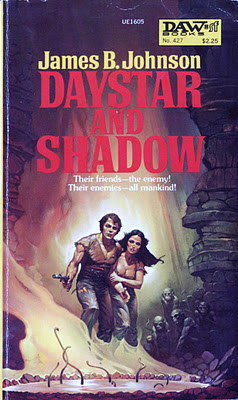
But let me be honest as to why I read Daystar and Shadow and, more importantly, why I happily finished it. A quick clue is the picture below. When it comes to science fiction, I enjoy post-apocalyptic worlds, unusual partnerships, strange and

After reading the novel, I still don’t know what to make of that tagline
evolving abilities, interesting creatures, solvable puzzles, and party building. Daystar and Shadow has a little bit of all of this.
But…the cover. What intrigued me more is: how the hell does this convocation of monkeys and snakes have anything to do with this rugged Han Solo-type and the clothes-defying girl on his arm? Throw in a laser gun in a desert setting and we’ve got a recipe for a science fiction romp. It turns out the snakes are fireworms(!) and the monkeys are masochists and the girl, well…the artist did a great job, and she isn’t nearly helpless or innocent herself.
Daystar and Shadow pulls in so many tidbits from so many science fiction tropes that, as Johnson puts his unique spin on the story, I overlooked what may bother modern readers. Including: occasionally stilted dialogue, flat secondary characters, improbable odds overcome, and juvenile descriptions of the female body–all of these seemed quite minor by the time I reached the conclusion. An ending that, in more ways than one, reminds me of the third Harry Potter novel. Featuring minor action and major explanations, the payoff is 70-80% guessable if you put together all of the clues, and that’s something I think many readers do enjoy.
Really though, fireworms should be reason enough to check this book out–I mean, fireworms. But when you add somewhat sentient monkeys, autistic armies, religious totalitarian control, and a convoluted galactic plot that just won’t leave two lonesome yet solitary desert nomads alone, you’ve got my attention for 206 pages.
Oh, and if anyone figures out the significance of the crabs–please let me know.
Episode 1: “Distilled Spirits”
Geno
—————————————————————————————————————————————————-
Like some young professionals, Geno has a handful of part-time jobs.
Like very few of them, he likes it this way.
Like many kids born in the 80s, Geno has no idea what society wants of him.
Like a surprisingly large amount of them, he’s pretty sure it’s everyone else that’s weird.
Expectations and decisions.
High school counselor and college advisor suggestions that were forgotten by lunch.
Geno can do a lot of things, but every day he sees people he never wants to be. Like the kind of person who wakes up on time for work.
______________________________________________________________________________
“You’re gonna be late,” a shape on the couch said when Geno stumbled out of his bedroom in a towel. Glenn was in a different country and there shouldn’t have been anyone else here.
“It’s 7:50,” the shape—Caitlyn said, uncovering her head and slender shoulders, long, brown, and tangled hair spilling out. A pile of clothes sat beside her.
“Are you naked?” Geno looked away and saw the apartment door was locked, the heavy bolt drawn across.
“This blanket felt sooooooo good last night. It was like—it was like part of me,” Caitlyn said, staring at the ceiling and hugging the pillowy white blanket.
Geno tugged his towel tighter and walked into the kitchen. He read the note on the fridge for the millionth time—‘Back in early August’—then opened the fridge just to hear the machinery hum. The apartment was too quiet when Glenn wasn’t around.
Taking out orange juice, Geno found the bread and dropped two slices into the toaster.
A high countertop separated the two rooms and he could see Caitlyn wriggle deeper into the couch. Geno wasn’t sure if she ever hid in his apartment when no one was around, but she probably did, and he hoped no one else knew the trick to the door.
“Want anything?” Geno called.
“No.”
“Wanna talk about it?”
“Don’t tell Sid I stayed here,” Caitlyn said, yawning. “He’ll just worry—okay?”
After the toast popped and Geno buttered it, he grabbed the remote from the fruit bowl and carried it all into the other room. He laid the plate on the small table next to Caitlyn.
“Put some Netflix on,” he said. “I gotta take a shower.
* * *
When Geno got out and dressed, Caitlyn was sitting up in her bra and held the blanket to her stomach.
She looked at her phone. “ 8:10—are they gonna fire you?”
“It’s freelance,” Geno said, grabbing his camera bag from beside the door. “So, I don’t know, actually.”
Caitlyn nodded but her eyes were on the TV that hadn’t been turned on. The orange juice was half finished and only nibbled toast crusts remained on the plate. Geno opened the door but before he left he tried to get Caitlyn’s attention. “Shower and stay as long as you want.”
She wouldn’t be there by the time Geno finished the job. Even now, her boyfriend was probably waiting for her to come back.
Outside.
The breeze carried an ocean chill—just the way Geno liked it. He didn’t like the dive-bombing seagulls as much, but affordable rent kept him in the Inner Harbor. Glenn practically owning the building also helped.
Geno could’ve called a cab and he was pretty sure a bus route shadowed his path, but both would’ve gotten him there too quickly. Being late to work was an important aspect of what he considered a form of performance art, though others called it laziness. He walked a fine a line, and any misstep could mean one of two things:
- He might be fired
- Worse, he might be promoted and given more responsibility
Ever since Geno dropped out of college, he’d successfully avoided either disaster.
The pier he was working at today was only a twenty minute walk away and after stopping for some street coffee and a doughnut, he was only forty-five minutes late. The lawyer was still waiting for him when he arrived though.
Cigarette butts littered the ground.
“You see that big tug at the end—the blue and white one?” the lawyer asked and pointed for a greeting.
Geno nodded.
“That’s the one. The Daisy or something—some girly name.” The lawyer glanced at Geno’s coffee cup and rubbed his hands together. “You got everything you need?”
Geno nodded.
“Good. Get shots of the dock—that’s what caused the damage. And you’re not getting paid for any artistic bullshit this time.”
When Geno left the lawyer and went down the pier, he took out his camera and the seagulls left their favorite spots like they were camera shy. Or hated him. There weren’t many people like Geno to hate—he was the only freelance maritime law photographer in the city. The other two had joined local firms, and last Geno heard, Smith, Smythe, and Smithers was thinking about hiring him.
That would mean regular hours. And more of them.
Geno popped the lens off and knelt, judged the light, and sighted along the pier edge. A small seagull had perched atop a jagged wooden chunk that poked out over the water. The bird cocked its head just as the sun broke through some low clouds-–click.
He glanced at the picture and adjusted his settings.
According to the e-mail that the lawyer had sent, the Daisy was actually called Dazai—the smallest tug in a small tug fleet operated by a Japanese family—and when Geno got to the boat, he noticed a number of things. But noticing things wasn’t his job so he quickly forgot that the tug was tied too closely and unevenly to the dock, and that her bow extended beyond the designated berth. After all, the tug boat family was the lawyer’s client, and the lawyer was paying Geno money.
He had gotten in trouble in the past for not knowing which side he was on.
Geno happily snapped away, edging closer to the 100 pictures that the lawyer requested, but he wasn’t sure what the last 85 would be. After the first 15 documented all of the superficial damage that the aging dock had caused to the Dazai, he had to get creative.
- 15 were unnecessarily close-up recreations of the first 15
- 10 were all shots of the same jagged dock piece with different things in Geno’s pocket used for scale
- 3 shots depicted the dollar bill that he had used for scale as it sadly sunk into the water
- 7 documented the trials of some ants in search of food on the dock
- the next 8 were wide angles of the scene that might’ve had shadow-puppets visible on the edge of the frame
- 13 were in black and white while Geno spoke to himself in a Detective-Noir voice
- 9 were serious shots again, because he was running out of ideas
- and the last 20 were divided between seagulls that arguably had part of the tug or the dock in the shot
- 3 more were thrown in—repeat attempts of his better ones
Always give a client more than they think they need.
Geno strolled back down the pier, whistling a nameless tune, and the seagulls returned in force to reclaim their territory. The lawyer had paid him for three hours and the job was done in thirty-five minutes.
The Chinese place on the way back was selling two dumplings for $1 and a nearly empty fridge waited for Geno back home. He only had a $10 bill and Han hated making change, so Geno called the apartment to see if Caitlyn wanted some but no one was there to answer.
_________________________________________________________________________________________________________________________
Hello! This is an introduction to Sci-Fi Undercover — the Cold Coffee feature that takes you and I into a Science Fiction novel that, while not forgotten by everyone, was probably forgotten by too many.
The idea is straight-forward: I will read a novel at a regular, unhurried pace and then I will talk about it. This isn’t a formulated review, a re-cap, or some kind of historical book report. And while neither is it a Read Along, I would love to hear from people who have read these books!
Simply, this feature is a selfish excuse to read a cool and old Sci-Fi book and then talk about it in-depth.
This first book grabbed my attention just yesterday at Dawn Treader, an amazing used book store in Ann Arbor, Michigan. Then I cheated and read the back and realized I had something. Henceforward, I decided to probably almost never cheat.
Title: Daystar and Shadow
Listed author: James B. Johnson
Copy: 1981, First (Only?) Printing, DAW Books
I’ve loved the first 10 pages, like many Sci-Fi books, and if you find a copy for less than 3 dollars it’s probably a good decision. But the next time you read Sci-Fi Undercover, you’ll have a much better idea.

Want to know what Distilled Spirits is?
Episode 1: “Distilled Spirits”
Sidney
_______________________________________________________________________________________
Like most Americans, Sidney wakes up early because he has to work.
Like many Americans, he only does this because he has to.
Like all people approaching 30, Sid is supposed to know where his life is going.
Like some people approaching 30, he’s stuck on what to have for dinner.
Deadlines and decisions.
High school existential problems that continue well past college graduation.
Sid wants to know many things, but what he doesn’t want to hear is that he isn’t very different than everyone else. And right now his employer is telling him that, in fewer words.
______________________________________________________________________________
“It’s shit,” his boss said. “It’s nothing new—nothing different than what’s been done.”
Sid had never heard his work described like that.
“You have until midnight to fix it. Call me.” His boss scanned the line of impatient customers that had formed. “Now, welcome to Burger Palace. How may I help you?”
Surveying the backlit menu above his boss’ register, Sid eyed the combos, weekly discounts, and deals that weren’t really deals. He didn’t want anything. He wasn’t hungry.
“Small fries.”
“For just fifty more cents—”
“Small,” Sid said, dropping exact change and taking his number.
The place was busy with an after work, after class, in need of terrible calories crowd. There was nowhere to sit, and when one family finished another slipped into their seats. A loosened-tie suit stood up from the counter and a student smoothly replaced him, probably discussed in the morning meeting.
Five hours. Five hours until Sid’s boss clocked out of his day job and expected a new line.
A couple waited beside Sid for their order. A couple, or two friends with one wanting more—lingering eye contact, a touch on the arm, stuck smile at a joke that wasn’t very funny.
“That wasn’t very funny,” the man said.
“I know,” the woman said, “I just can’t stop thinking about my promotion.”
“Head of Sales, right?”
“Yes,” she said. “In six months I could be Director of Sales.”
Sid crumpled his receipt and left Burger Palace.
The apartment he shared with Cait was four blocks away, enough time to finish an order of small fries, a bottle of beer, or a cigarette, but never all three. Past liquor stores, laundromats, and only one Mexican-Thai fusion joint—his neighborhood was low on the list to be gentrified, still hosting a few genuinely, not-playing-around homeless people.
But just a few, and Crazy Man Joe was the most interesting one he had met so far.
Sid climbed his building’s steps without checking to see if the elevator was fixed and tried to unlock the door to his 4th floor apartment.
“Hello?” he called into his own home when his door just swung open. “Cait, you okay?”
The apartment smelled like Jamaican spice, chili powder, and chicken. Like cooking—real cooking, not microwave pizza and burned waffles.
“Geno, is that you?” Sid tried again.
“Come in—dinner’s up in ten minutes.” Geno. One of many people who didn’t live in the apartment.
Sid closed the door and dropped his leather briefcase. It was an empty briefcase, but it gave him authority when he had to meet people.
“Caitlyn left it unlocked,” Geno explained in between microwave beeps. The kitchen sizzled and smoked and so did the dining and living room as only a couch divided them. “She’s gone, by the way.”
“Gone?” Sid reached for the doorknob. “What—which hospital?”
“No, I mean gone.” Geno turned the stove down and looked over his shoulder. “She and her boyfriend are passed out in her room. Out for the last two hours.”
Sid flopped onto the couch that faced the entertainment set. He watched the half-dozen different fish go about their important duties. Sometimes there were seven, other times five, and one time Sid swore he saw eight—separated on either side like it was some kind of soccer scrimmage. But most of that night with Cait was fuzzy.
Most people would call the entertainment set a fish tank.
“Wait,” Sid said, “you’ve been here for two hours? Don’t you have like five jobs?”
“Three hours. You shoulda seen Caitlyn and him. They hit it pretty hard.” Geno opened a cupboard and another, taking out some plates. “Your mail’s on the table.”
“Where the shit is Glenn, anyway?” Sid muttered. “Why are you here?”
“He’s in South America for a bit and I wanted to make chicken tacos. My place is too quiet.”
“Wanna swap apartments?” Sid reached for the dimmer switch and the fish tank backlight faded to a more subtle blue.
“Where’s your furikake?” Geno asked. The sizzling had stopped.
“Next to the fish food.” Sid followed the only goldfish as it darted among the others. He wasn’t sure where that one came from—Glenn only stole from Chinese restaurants. “Are you gonna ask how it went?”
“He didn’t like the line?”
“ ‘You’re a winner’—what’s wrong with that?” Sid sniffed the air—dinner would be over spiced, exactly the way he liked it.
“Pretty classic,” Geno said. “It has some retro appeal. Wait, what was the game again? Who was the final boss?”
“A dragon vampire,” Sid said, sitting up. “Don’t laugh—hold on. It’s not that stupid, and the girl he got to do the art is the real thing. Cooper Mellon student or something. And listen—it isn’t just a dragon vampire: it’s the last of it its kind.”
Geno had stopped plating the food to listen, spatula at his lips.
No response.
“Hey,” Sid said, “I just wrote the script—I didn’t design the game.”
“Last of its kind, right?” Geno said suddenly, biting burned bits off the spatula. “You could use that. What if—after you kill the boss—the line is: ‘You’re a winner, but at what cost?’ ”
Sid glanced back at the fish tank. The goldfish stopped moving for a moment.
“Goddamnit,” Sid said.
“Whhabt?” Geno had half the spatula in his mouth.
“No—fuck you, goddamnit. That’s actually kinda good. I’m gonna try it. Don’t say anything. We’ll eat in a second.”
Sid found his phone and stepped closer to the bubbling fish tank, away from whatever Geno might say or sounds he might make while devouring utensils.
He dialed his boss’ number and told him Geno’s line.
“That’s it! That’s what we need,” Sid’s boss shouted—sounds of Burger Palace in the background. “I’ll publish the game next week.”
“Great—fine,” Sid said. “If you, if you or someone has some work, send ‘em my way.”
“Sure, Sidney. Now,” his boss lowered his voice, “do you want the $100, or can I get you some pot?”
“Just the money,” Sid said, hanging up. “Don’t say anything.”
Geno removed the spatula from his mouth. “Dinner’s ready.”
——————————————————————————————————————————————————————————
 Devon Claytor